


Across the sprawling savannas and coastal hinterlands of West Africa, climate change is no longer a distant environmental forecast it is an existential, daily reality. Changing rainfall patterns, shrinking water supplies, and the relentless degradation of arable land are pushing traditional agrarian communities to their absolute limits. As fertile earth vanishes, the fierce competition for land and water between farmers and pastoralists is igniting a cascade of displacement, economic hardship, and regional instability.
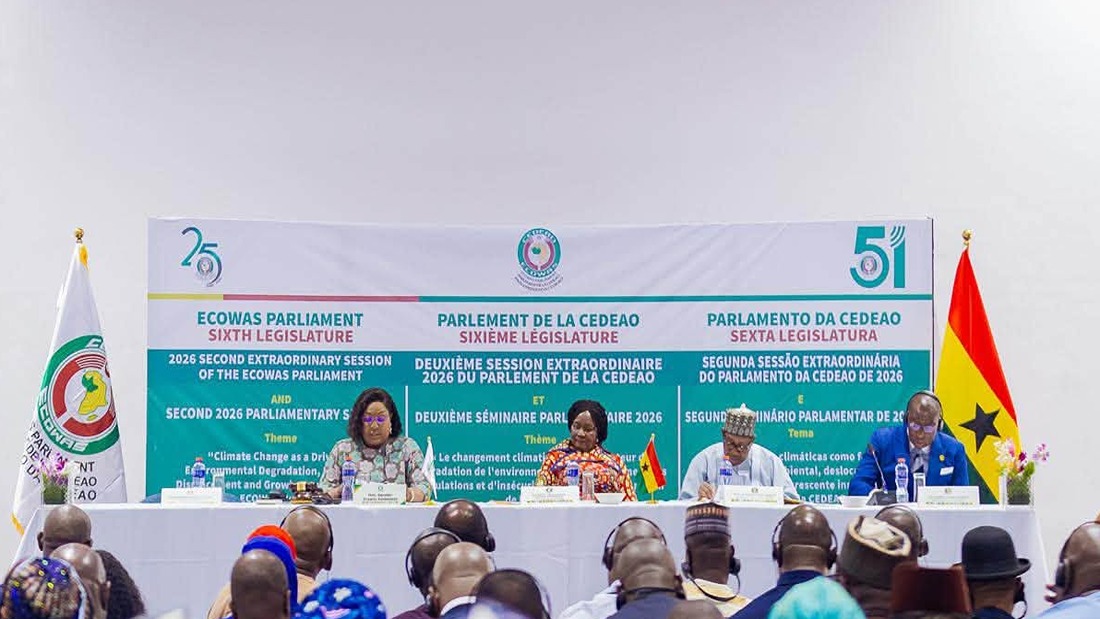
These escalating pressure points took center stage in Accra, Ghana, where lawmakers convened for the Second 2026 Parliamentary Seminar of the Economic Community of West African States (ECOWAS). Delegations from across the bloc presented stark evaluations of how changing weather patterns are dismantling local economies and driving internal migration. Far from being a simple environmental debate, the deliberations highlighted a far more complex reality: ecological disruption has become a primary engine of regional insecurity and human suffering.
Nigeria’s delegation presented a comprehensive picture of this interconnected crisis. Home to a vast agricultural and pastoral workforce, the nation is battling a convergence of rapid population growth, climate variability, and shifting migration routes. The human toll is already immense. According to International Organization for Migration figures cited at the seminar, Nigeria recorded over 2.2 million internally displaced persons (IDPs) in its North-East, with an additional 1.3 million displaced across the North-Central and North-West regions following 2025 assessments.
“In Nigeria, internal displacement has been linked to armed conflict, communal violence, farmer-herder conflict, banditry, terrorism, flooding and other disasters,” the report detailed. The presentation underscored that access to pasture and water is no longer just an economic consideration, noting that “for communities dependent on agriculture and livestock, access to land and water is not merely an economic issue but a matter of survival.” Delegates further cautioned against reductive views of the violence, emphasizing that “farmer-herder conflicts cannot simply be viewed as disputes between two groups,” as banditry, organized crime, and fragile dispute-resolution systems complicate the landscape.
To navigate these shifting dynamics, member states are rolling out targeted, localized strategies. In Togo, where seasonal livestock movements frequently cross agricultural zones, authorities adopted a new 2026–2030 strategic framework under their long-standing National Transhumance Committee. The goal is to modernize historical livestock routes before environmental pressure spills over into violence. As the seminar noted, when customary routes become blocked or water holes evaporate, weak dialogue channels can rapidly allow environmental friction to transform into a national security threat.
Meanwhile, The Gambia showcased a community-centered approach through Phase II of its Participatory Integrated Platform for Resilience and Food Security (P2P2RS). Reaching smallholders, herders, and agro-pastoralists across 19 districts, the initiative pairs climate-smart farming, post-harvest equipment, and irrigation with conflict-sensitization programs focused on cattle tracks and shared grazing areas. Island nations face their own unique vulnerabilities; Cabo Verde highlighted how acute water scarcity forces changes in agricultural production, setting off chain reactions that alter migration flows and heighten competition over scarce municipal resources.
Faced with these compounding threats, parliamentarians at the Accra assembly called for a fundamental pivot away from basic emergency relief toward structural, long-term intervention. Delegates stressed that durable solutions for displaced populations require safe returns, secure land rights, and restored livelihoods, arguing that military responses alone cannot fix deep-seated resource imbalances. By strengthening cross-border early-warning systems, land governance, and climate adaptation budgets, ECOWAS lawmakers aim to intervene before environmental shocks turn into humanitarian emergencies. As the seminar concluded, because rivers, weather patterns, and pastoral routes ignore national borders, West Africa’s path to stability relies on a unified, regional response.